
Comanche County Arrest Records and Court Charges
A Comanche County arrest record starts at the moment of the arrest. It captures the arresting agency, the date, and the booking at the county jail. In many local cases the arresting agency is the Lawton Police Department or the county sheriff. The record may also list the early charges read at booking. Those booking charges are not the final word. After an arrest, the district attorney reviews the case and decides which formal charges to file with the Court Clerk. Once filed, those charges become the court charge record, and they are what the court tracks from that point forward.
The two records sit on different sides of the system. The arrest and booking detail belongs to the sheriff and the jail, so the live roster and booking facts are covered on the Comanche County inmate records page. The court charge record shows what the prosecutor actually filed and how each count moves through the case. It is the cleaner source for court charges after arrest. For the full case file, including pleas, hearings, and the final outcome, the criminal court records page goes deeper.
Release can come before the charges are even formally filed. For a set list of misdemeanors, the Comanche County Detention Center allows a weekend bond release with fixed cash amounts when the courthouse is closed. DUI, public drunk, and similar arrests carry an eight-hour wait after booking. Many offenses are excluded outright, including anything tied to weapons, violence, or a domestic charge.
How to Find Comanche County Arrest Records
Filed charges in Comanche County are searched through the Oklahoma State Courts Network, known as OSCN. The free OSCN docket search covers District Court cases, including felony, misdemeanor, and traffic counts. Booking charges at intake are a separate matter, and the live jail roster is reached through the inmate records page. For the court charges, OSCN is the first stop.
- Open the OSCN docket search and pick Comanche County District Court from the court list.
- Search by the defendant's last and first name, or type the case number such as CF-2024-1.
- Open the case and read the Counts section, where each filed charge is listed.
- Check each count for its statute link, severity level, and current status.
A name search can return more than one person, so a date of birth range helps narrow it. OSCN also lets a searcher filter by party type, including defendant, arresting agency, arresting officer, and district attorney, which is useful when a common name pulls many hits. Filed charges that are public can be inspected and copied under the Oklahoma Open Records Act, 51 O.S. § 24A.5. When a charge document is not posted online, OSCN often marks it available at the Court Clerk's office, and a copy can be requested in person or by mail.
Note: OSCN searches District Court cases only, so Lawton and Cache city ordinance charges must be checked through their own municipal court systems.
Filing Charges After a Comanche County Arrest
Charges do not file themselves. After booking, the charge record opens when the prosecutor files a charging document with the court. In Comanche County, that prosecutor is District Attorney Kyle Cabelka, whose office decides the counts and the level of each one. Most cases begin with a complaint or an information. The most serious felonies can instead come from a grand jury indictment. A defendant who cannot afford a lawyer may be represented through the Oklahoma Indigent Defense System Lawton office.
| Complaint | Information | Indictment | |
|---|---|---|---|
| Filed By | Officer / Prosecutor | District Attorney | Grand Jury |
| Common For | Misdemeanors | Many felonies | Serious felonies |
| Starts | The case | The case | The case |
One arrest can lead to a single count or to several. The charging document sets the starting point, and every later change in the case is measured against it. On OSCN, the Counts section lays out each count as filed, the offense text, a statute link, and the date of offense. A criminal case is styled State of Oklahoma versus the defendant, and the arresting agency, such as the Lawton Police Department, appears as a named party.
Comanche County Charge Status Explained
A charge is not fixed once it is filed. As a case moves, counts can be amended, reduced, added, dropped, or dismissed. The status field in the record shows where each count stands. Reading it correctly keeps an old accusation from looking like a current one.
Charge status can shift even after a case appears finished. In November 2025, the Comanche County district attorney appealed a dismissed firearm case to the Oklahoma Court of Criminal Appeals after a judge denied a continuance request.
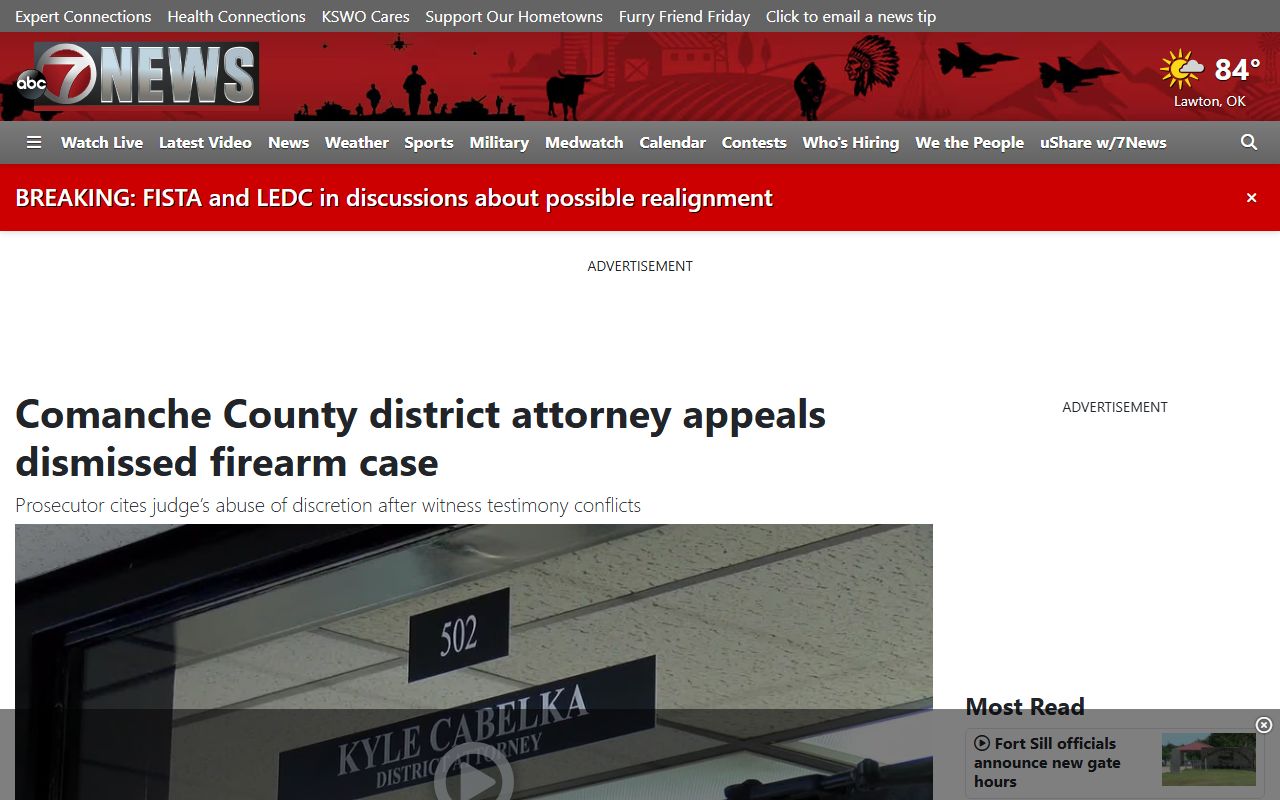
That appeal is a reminder that a dismissal at the District Court is not always the end of a charge. The same charge can be revived, refiled, or sent up for review.
| Status | What It Means |
|---|---|
| Pending | The charge is filed and the case is still open and moving through the court. |
| Amended / Reduced | The count was changed, often to a lower level or a different statute. |
| Dismissed | The court dropped the charge, by motion, plea deal, or lack of proof. |
| Nolle Prosequi | The prosecutor chose not to pursue the charge, ending it without a conviction. |
Note: Always read the most recent docket entry, because a charge listed as pending one week can be amended, dismissed, or resolved by the next court date.
Comanche County Charge Codes and Levels
Every charge ties back to a statute. The count text names the offense, and a statute link points to the exact law, such as 21 O.S. 652 on a felony count in the sample case CF-2024-1. The case number prefix also signals the charge level. One arrest can produce several counts at different levels.
- CF marks a criminal felony case, the most serious level.
- CM marks a criminal misdemeanor case.
- TR marks a District Court traffic case.
- WL marks a wildlife offense.
- YO marks a youthful offender case.
Felonies carry the heaviest possible penalties. Misdemeanors are lower-level offenses, and traffic counts sit lower still. Knowing the prefix tells a reader how serious a charge is before reading a single docket line.
Charges vs. Convictions
Being charged is not the same as being convicted. A charge is an accusation that the state must still prove. A conviction comes only after a guilty plea, a no contest plea, or a verdict at trial. Many filed charges end without a conviction, through dismissal or acquittal, and a charge record should be read with that in mind.
| Charge | Conviction | |
|---|---|---|
| Stage | Accusation | Verdict or plea |
| Burden of Proof | Probable cause | Beyond reasonable doubt |
| Public Record | Yes | Yes |
Statewide Charge and Criminal History Lookups
County charges roll up into a statewide criminal history. The Oklahoma State Bureau of Investigation keeps the official state file, while the courts hold the case-level charges. Two state tools sit alongside the court record. The Department of Corrections offender lookup covers people sentenced to state custody, not pretrial jail inmates. The state sex offender registry is a separate database again.
Sentenced offenders are tracked at the state level through the Oklahoma DOC offender lookup.
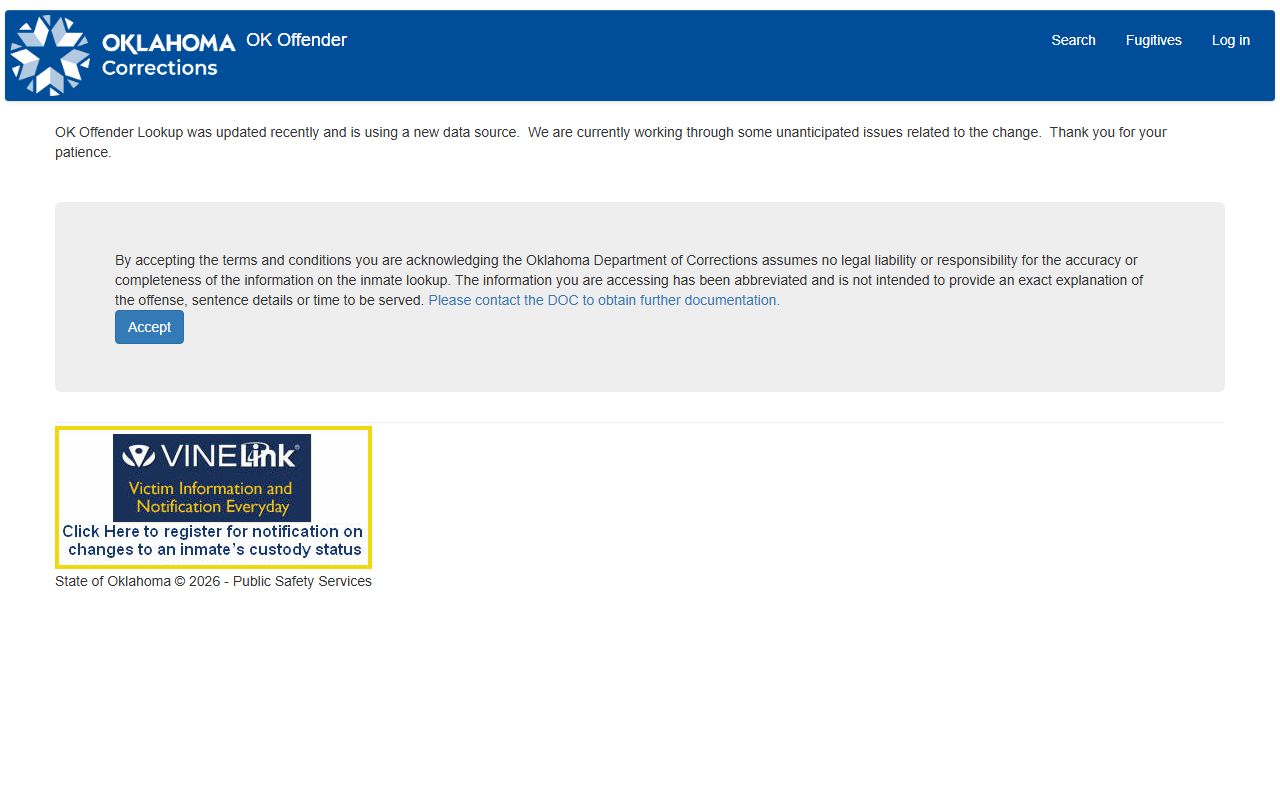
The DOC warns that its results are abbreviated and do not spell out the full offense or sentence, so the court file stays the better source for the charges themselves. The state sex offender registry is searched on its own portal. Some law enforcement material can be withheld during an active investigation under 51 O.S. § 24A.8, even when the eventual court charge is public. The Comanche County Sheriff's Records Division runs around the clock and verifies warrants and protective orders tied to local charges.
Sealed vs. Expunged Records
Some charges leave the public record entirely. Oklahoma law allows sealing and expungement under 22 O.S. § 18 and related provisions. The Oklahoma State Bureau of Investigation explains the expungement process and charges a $150 processing fee to expunge an arrest record, while sealing the court record is free. A deferred sentence under 22 O.S. § 991(c) changes the disposition to a not-guilty plea and dismissal, but it does not erase the arrest record.
| Sealed | Expunged | |
|---|---|---|
| Visibility | Hidden from public | Destroyed / treated as never existed |
| Law Enforcement | Limited access | Very limited |
| Eligibility | Court order under 22 O.S. § 18 | Arrest-record expungement through OSBI, $150 fee |
Background Check Considerations
Court charges often turn up in background checks, but not all checks are equal. A formal background check used for hiring, housing, or credit must follow the federal Fair Credit Reporting Act. A casual name search on OSCN does not. The two serve different purposes, and the rules that govern them differ. A free court search is fine for personal awareness, yet it is not a screening report.
Important: Comanche County Court Records is not a consumer reporting agency under the FCRA, and nothing here may be used for employment, tenant, credit, or insurance screening.
Restricted Charge Records in Comanche County
Not every charge is open to the public. Juvenile charges are confidential under 10A O.S. § 2-6-102 and do not appear in the open District Court index. Sealed and expunged charges are removed from public view. Charges still under active investigation can be withheld, and a dismissed count may be screened from some searches. Personal identifiers such as Social Security numbers are redacted from records that are otherwise public.
Criminal copies from the Court Clerk follow stricter rules than a routine request. The criminal records office takes written requests by mail or in person only, charges a search fee, and does not accept criminal-record or background-check requests by email.
Note: A clean OSCN search does not always mean a clean history, because sealed, juvenile, and out-of-county charges may simply not show up in a Comanche County District Court result.