
Criminal Court Records in Comanche County
A criminal court record is the case file the Court Clerk opens once charges are filed. It is not a single sheet. It is a running record that tracks every filing, hearing, and order from the first charge to the last cost paid. The Comanche County Court Clerk keeps these files in the criminal division at the courthouse on the fifth floor. Clerk Robert Morales runs an office of about 21 deputies split across three units, and the criminal unit in Suite 504 handles felony, misdemeanor, traffic, and wildlife cases. The clerk records and files each step, collects fines and fees, and guards the integrity of the case under state law.
District Court hears these cases. Comanche County sits in Judicial District 5 and lists seven judges on its bench. Felony cases carry a CF case number, and misdemeanor cases carry a CM number. City ordinance offenses are different and route to the Lawton or Cache municipal courts instead. For a wider look at every kind of filing the clerk keeps, the full set of Comanche County court records covers civil, family, probate, and small claims files alongside the criminal docket.
How to Search Comanche County Criminal Court Records
The main search tool is the Oklahoma State Courts Network, known as OSCN. It is free, and it covers District Court dockets for the whole county. The OSCN docket search lets you look by party name or by case number. It does not search Lawton or Cache city citations, which live in separate municipal systems. Pick the county court first so your results stay local.
- Open the OSCN docket search and pick Comanche County District Court in the county or court dropdown.
- If you know the case number, type it in and submit. A felony reads as CF, and a misdemeanor reads as CM.
- If you only have a name, enter last and first name, and add a date-of-birth range or a party type to trim the list.
- Set the case type to Criminal Felony or Criminal Misdemeanor, and add filing or closed dates to narrow broad results.
- Open a case to read the style, judge, parties, counts, docket entries, and disposition, then request a certified copy from the clerk if you need one.
OSCN shows the docket detail at no cost. Many document images are not posted online, and the entry instead reads "Document Available at Court Clerk's Office." When that happens, note the docket title and the case number, then file a request with the clerk for the copy.
Note: OSCN searches District Court cases only, so a missing result may simply mean the charge was filed in a city municipal court rather than the county District Court.
Stages of a Comanche County Criminal Case
A criminal case moves through set steps, and each step leaves a mark in the record. The case starts when the District Attorney files charges. It ends at sentencing or with a dismissal. Reading the docket in order shows how the case traveled from one stage to the next.
Case flow: Charges Filed › Arraignment › Pretrial / Motions › Plea or Trial › Disposition › Sentencing
| Stage | What Happens |
|---|---|
| Arraignment | The defendant hears the charges, learns their rights, and enters a first plea. Bond terms are often set here. |
| Pretrial / Motions | Lawyers file motions, swap evidence, and argue what the jury may hear. Many cases settle at this stage. |
| Plea or Trial | The defendant pleads, or a judge or jury weighs the proof. The State must prove guilt beyond a reasonable doubt. |
| Sentencing | After a guilty plea or verdict, the judge sets the penalty. The court minute on the docket holds the full sentence detail. |
Prosecution and Defense in Comanche County Criminal Cases
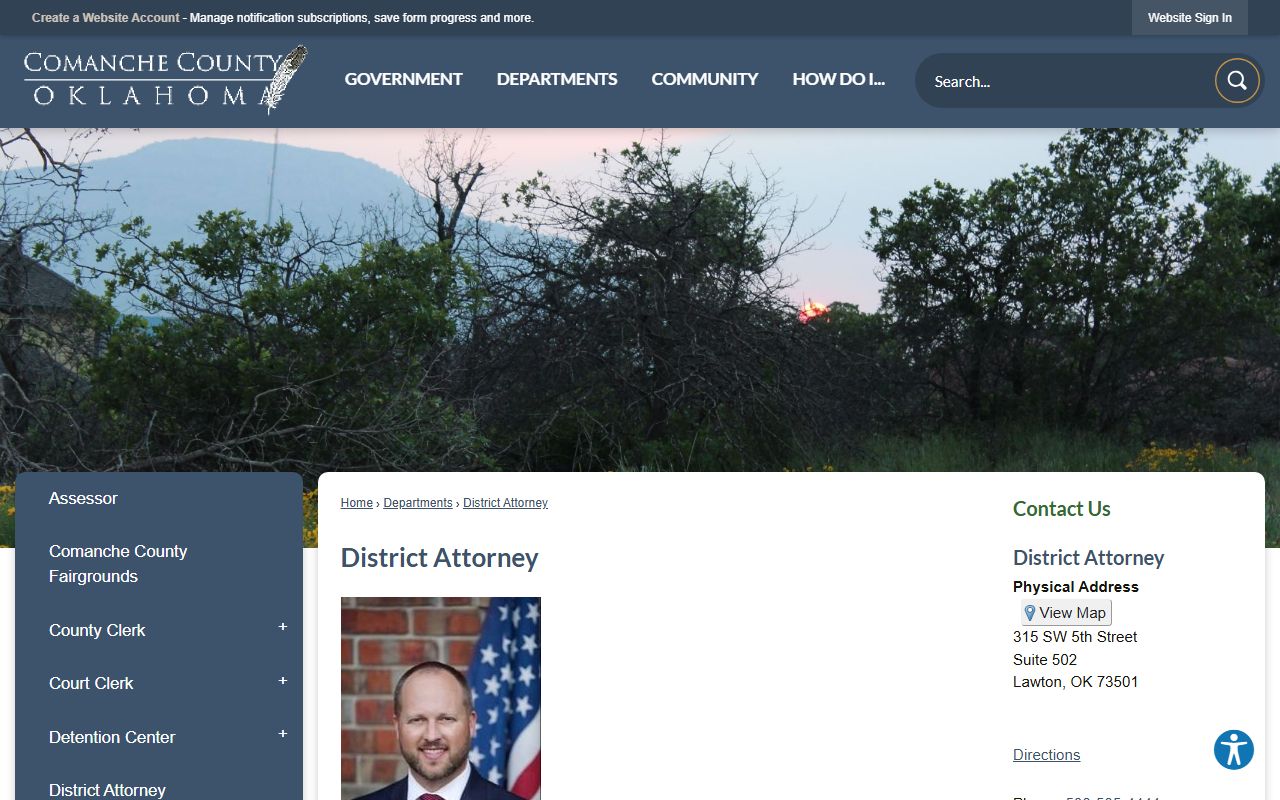
The District Attorney is the charging authority for state crimes in the county. Kyle Cabelka leads the office at the courthouse, and his prosecutors decide what counts to file and how to pursue each case. The DA, not the police, controls the formal charges that drive the court record. A look at the county District Attorney page shows the office contact block and its role in District Court cases.
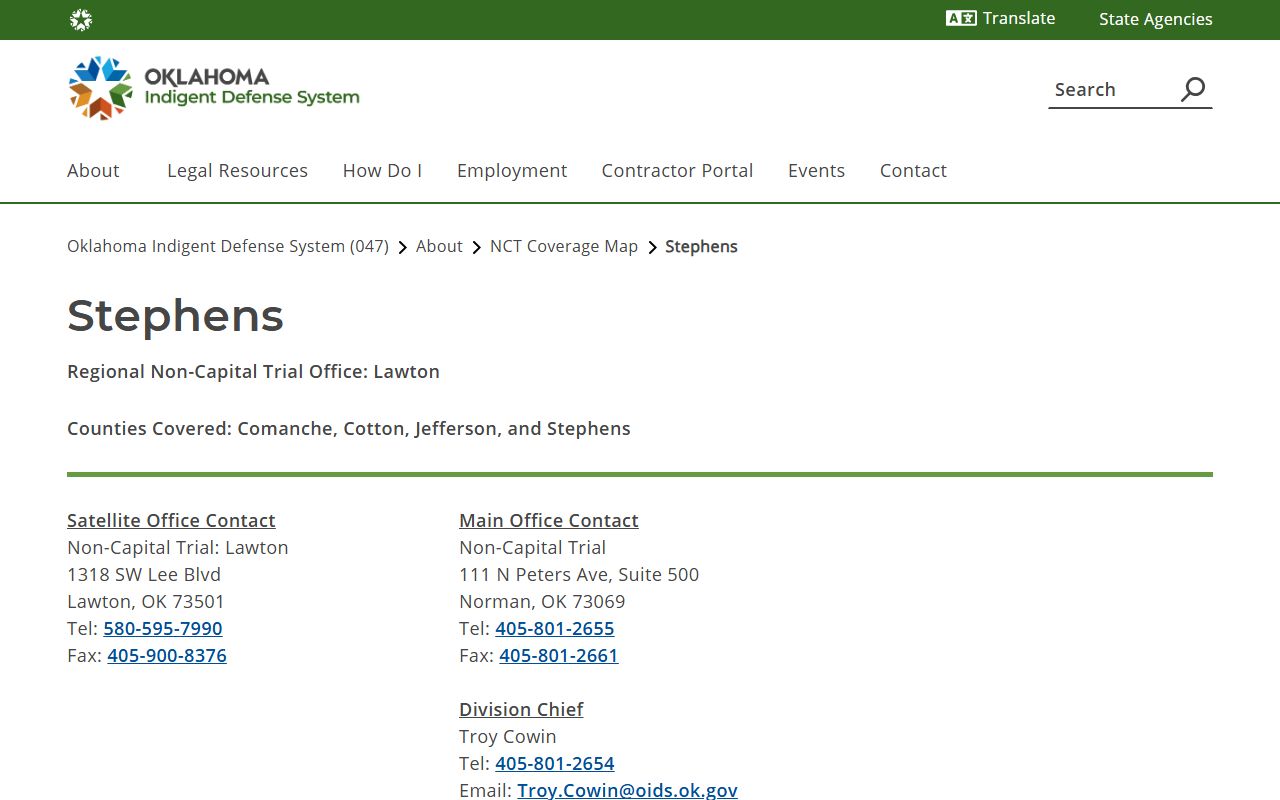
Every criminal case file names the State of Oklahoma, the prosecutor, the arresting agency, and the defense counsel. People who cannot afford a lawyer may qualify for a court-appointed defender. The Oklahoma Indigent Defense System runs a Lawton trial office that covers Comanche County and nearby counties. Its regional non-capital trial office handles felony and misdemeanor defense for those who meet the income test.
The names of the prosecutor and the defense lawyer both appear in the docket parties. That detail helps confirm you have the right case when a common name returns many results.
What a Comanche County Criminal Court Record Shows
The criminal case file is built from labeled fields. OSCN groups them into headers, counts, events, dockets, and financial entries. A sample felony case in the county, filed as CF-2024-1, shows the layout well. Its counts list the offense text, a link to the statute, and the offense date, while the docket notes where each document can be found.
| Field | What It Shows |
|---|---|
| Case Number | The court's tracking number. A CF prefix marks a felony, and a CM prefix marks a misdemeanor. |
| Defendant | The person charged, listed against the State of Oklahoma in the case style. |
| Charges | Each count as filed, with the offense text and a link to the cited statute, such as 21 O.S. section 652. |
| Plea | The defendant's response: guilty, not guilty, or no contest. |
| Disposition | The outcome of each count, with the violation and statute fields tied to it. |
| Sentence | The penalty after a conviction. The full detail sits in the court minute posted on the docket. |
Other fields round out the file. The record names the judge, the filing and closed dates, the attorneys, and the arresting agency, such as the Lawton Police Department. Bond events, warrants, motions, and cost entries all appear as dated docket lines. The charges themselves get a closer look on the Comanche County arrest records and court charges page.
Reading Dispositions and Sentences
The disposition is the heart of the record. It tells you how each count ended. A case can close many ways, and the words used carry weight. Knowing the terms helps you read a file without guessing.
- Guilty
- The defendant admitted the charge or was found guilty, which leads to a sentence.
- Not Guilty
- A judge or jury cleared the defendant, and no conviction stands on that count.
- Dismissed
- The court dropped the charge before a verdict, sometimes at the request of the State.
- Nolo Contendere
- A no-contest plea. The defendant does not fight the charge but does not admit guilt.
- Deferred
- The court holds off on a final judgment while the defendant meets set terms over time.
The sentence follows a conviction. It may set jail or prison time, probation, fines, and court costs. Probation means supervision in place of, or after, time behind bars. The docket records each payment and each review, so a sentence reads as a living entry, not a single line.
Charges vs. Convictions in Comanche County Criminal Records
Being charged is not the same as being convicted. A charge is an accusation. A conviction is a final finding of guilt. A Comanche County criminal court record can show charges that were dropped, dismissed, or that ended in an acquittal. Reading only the charge and skipping the disposition gives a false picture of the case.
| Charge | Conviction | |
|---|---|---|
| Stage | Accusation | Verdict or plea |
| Burden of Proof | Probable cause | Beyond reasonable doubt |
| Public Record | Yes | Yes |
The lesson is simple. Always read the disposition next to the charge. The count may have been reduced, dismissed, or sent to a deferred outcome, and only the disposition shows that result.
Comanche County Drug Court and Diversion Records
Some cases do not end in a standard sentence. They route into a treatment-based program instead. The county staff directory lists a Drug Court and Mental Health Coordinator tied to the District Attorney's office, which points to local treatment-court work. These programs give eligible non-violent felony defendants supervised treatment in place of prison time.
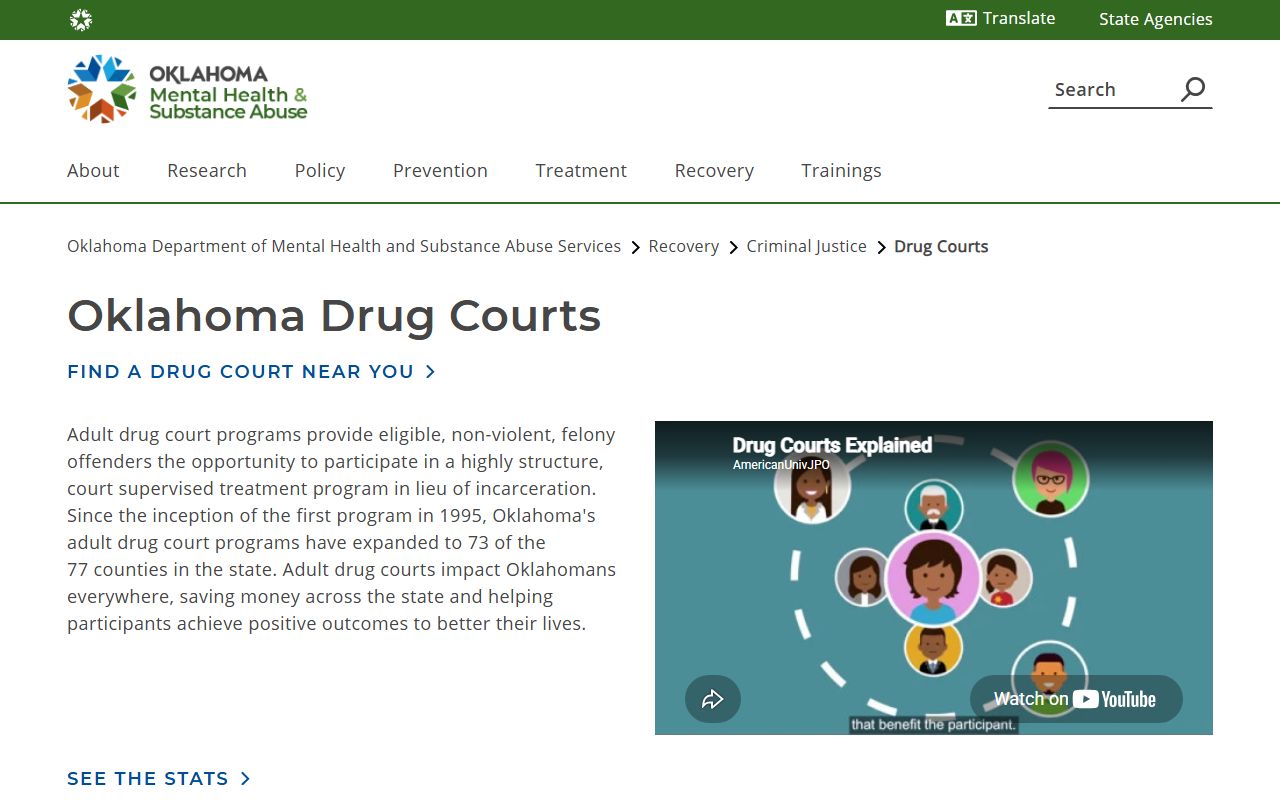
Statewide background helps explain how these courts run. The Oklahoma drug court program began in 1995 and has spread to most of the state's 77 counties. A defendant who joins still has a case file, and the docket tracks status hearings, treatment terms, and the final result.
When a participant finishes the program, the disposition often changes to reflect a dismissal or a reduced result. That change shows in the docket, so the record still tells the full story of how the case closed.
Requesting Comanche County Criminal Records by Mail
OSCN shows the docket, but certified copies come from the Court Clerk. The criminal office in Suite 504 handles these requests by mail or in person only. The criminal records request page explains the steps, the fees, and the rules. A written request needs the subject's full name, date of birth, Social Security number, the offense date, and the case number if you have it.
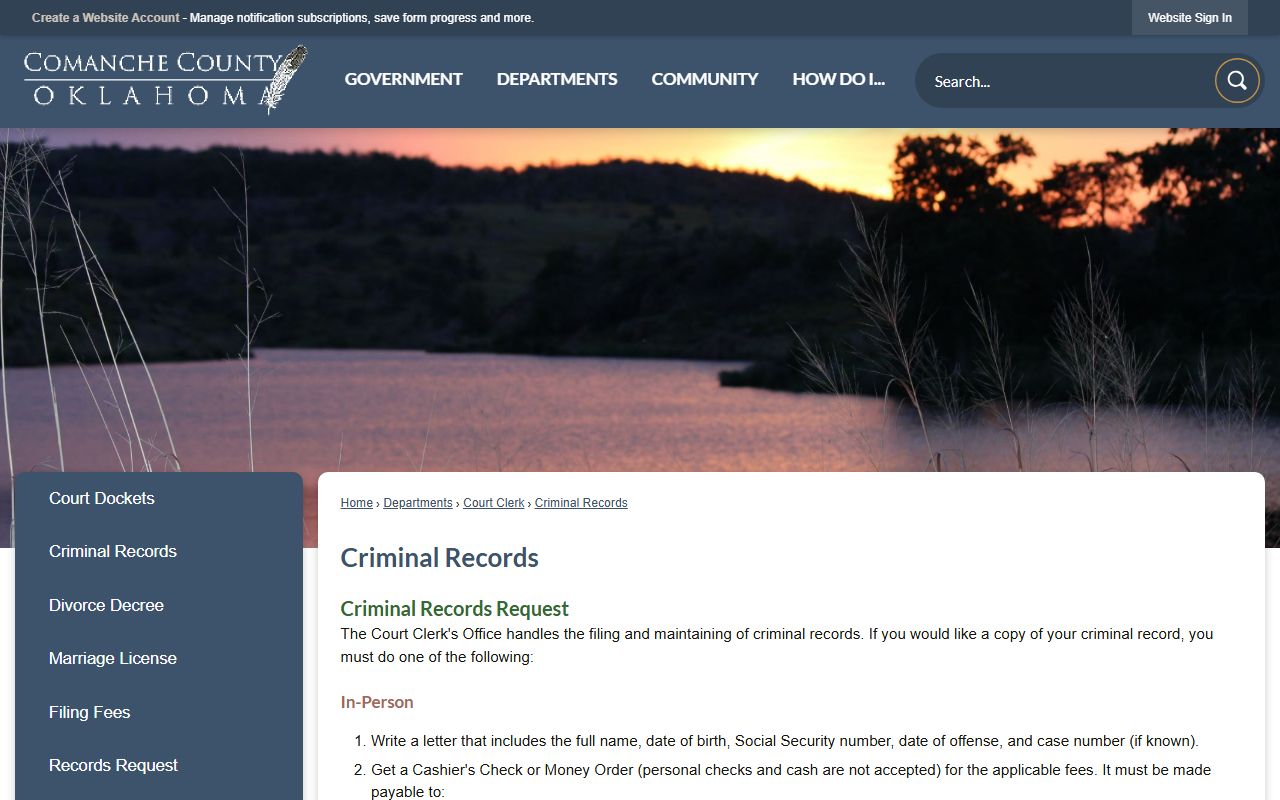
The fee structure is set. A criminal record search costs $10. The first page is $1.50, and each added page is $0.50. Mail payment must be a money order or a cashier's check made out to the Comanche County Court Clerk, since personal checks and cash are not taken by mail. You can also fill out the general records request form, enclose a self-addressed stamped envelope, and call 580-355-4017 and press 1 to confirm the page count and cost.
Important: The Court Clerk's criminal office does not accept criminal-record or background-check requests by email. Requests must arrive by mail or in person with the fee enclosed.
Note: Older cases may not be ready the same day, so call the clerk before a courthouse visit to confirm the file can be pulled and copied while you wait.
Sealed vs. Expunged Criminal Records
Not every criminal record stays public forever. Oklahoma law lets some people seal or expunge a record under set terms. The two paths differ in scope and cost. The Oklahoma State Bureau of Investigation holds the state criminal-history file, and its expungement page explains how the relief works.
| Sealed | Expunged | |
|---|---|---|
| Visibility | Hidden from public | Destroyed / treated as never existed |
| Law Enforcement | Limited access | Very limited |
| Eligibility | Section 991(c) updates a deferred sentence to show a not-guilty plea and dismissal | Section 18 can seal the full arrest record under 22 O.S. |
The cost is not the same for each layer. OSBI says expunging the court record is free, while expunging the arrest record carries a $150 OSBI processing fee and may add local agency fees. A Section 18 order is broader and can seal the arrest record itself. A Section 991(c) update only changes a deferred-sentence disposition, and it does not remove the arrest record. People file in the court where the case sits, which for county cases is the Comanche County Court Clerk.
Public Access to Comanche County Criminal Records
Criminal case files are public records in Oklahoma unless a law makes them confidential. The Open Records Act sets the baseline right to inspect and copy records held by public bodies. District Court dockets meet that test, which is why OSCN posts them for free. The Court Clerk supplies copies under the same framework.
Key Statutes:
Oklahoma Statutes 51 O.S. § 24A.5 - public records are open for inspection and copying during regular business hours, subject to set confidentiality exceptions.
Oklahoma Statutes 51 O.S. § 24A.8 - governs what law-enforcement agencies must release and what investigatory material they may hold back.
Note: Access is broad, but a court can still seal a file, redact identifiers, or withhold an active investigation when state law allows it.
Background Check Considerations
A casual lookup and a formal background check are not the same. OSCN and a clerk copy are fine for personal research. A regulated background check used for hiring, housing, or credit must follow the federal Fair Credit Reporting Act and run through a licensed screening firm. The county does not provide an FCRA report.
Important: This site is not a consumer reporting agency under the FCRA, and its information may not be used for employment, tenant, credit, or insurance screening.
Federal Criminal Cases Near Comanche County
Not every criminal case in the area is a county case. Federal crimes route to the U.S. District Court for the Western District of Oklahoma, which keeps a courthouse in Lawton. Cases tied to Fort Sill or to federal law often land there. These files do not appear on OSCN.
The federal prosecutor is the U.S. Attorney for the district. The U.S. Attorney's Office charges and tries federal crimes, and its records sit in the federal PACER system rather than the state court network.
Keep the systems separate when you search. A county felony lives on OSCN under a CF number, while a federal case lives on PACER under a federal docket number.
Restricted Comanche County Criminal Court Records
Some criminal files are closed to the public even though most are open. State law shields certain people and certain stages. Knowing the limits saves a wasted trip to the clerk.
- Juvenile cases are generally confidential under 10A O.S. section 2-6-102 and are not open public files.
- Sealed and expunged cases drop out of public view once a court grants the order.
- Adoption files connected to a case are highly restricted and are not treated as ordinary records.
- Mental-health proceedings are restricted where state law makes them confidential.
- Personal identifiers such as Social Security numbers, account numbers, and minor names are redacted.
When a record is restricted, the docket may still show the case exists while hiding the detail. For anything tied to an arrest or an active warrant, the county warrant records page explains who to contact next.